




Neurodiversity, STAR, and Interviewing
As we see more reorganization within large companies, individuals reapplying for their positions or trying to move laterally or toward promotion are often experiencing significant stress and strain. What I notice as a therapist is that interview processes can become especially difficult for some neurodivergent individuals.
I am writing from both clinical and lived experience. I am a neurodivergent therapist who works with neurodivergent clients, and I know personally and professionally how interviews can become difficult in ways that are not always visible from the outside. In my practice, I often work with individuals who leave interviews questioning their competence, confidence, self-concept, or whether they should say anything at all about being neurodivergent. From this lens, interview format deserves attention because it can shape both performance and the meaning people make of that performance.
Many workplaces use structured interviews to evaluate candidates for jobs, promotions, and internal opportunities. The STAR method is a behavioral interviewing framework widely associated with Development Dimensions International (DDI), which traces its introduction of the model to 1974.
STAR stands for:
Situation: The context
Task: The responsibility or goal
Action: What the candidate did
Result: The outcome
The framework is intended to help interviewers gather concrete examples rather than broad claims. A candidate might hear questions such as, “Tell me about a time you handled a difficult client,” or “Describe a situation where you led a team through conflict.” Interviewers often hope for an answer that is specific, clear, organized, and chronological.
In practice, this kind of behavioural question-and-answer framework calls upon a particular set of mental skills. A candidate needs to retrieve a relevant memory quickly, hold the sequence in mind, decide which details matter most, and present the example clearly while being evaluated. STAR questions therefore reflect more than experience alone. They also draw upon a person’s ability to organize past events into a concise spoken narrative in real time.
For some candidates, that process feels natural. For others, including some neurodivergent people, the challenge may lie in having to describe their experience in a fast, highly structured way.
Neurodivergence and Interview Performance
Neurodivergence refers to natural variation in how people process information, regulate attention, organize thought, retrieve language, and communicate experience. The term is often used as an umbrella for differences such as autism, ADHD, dyslexia, dyspraxia, dyscalculia, Tourette syndrome, and other learning or neurodevelopmental differences. In workplace settings, this matters because interviews often reward one communication style more strongly than others.
Many jobs call for judgment, creativity, follow-through, collaboration, problem-solving, strategic thinking, and the capacity to manage complexity over time. Structured interviews, especially those built around STAR responses, often place substantial weight on a narrower skill: the ability to translate lived work experience into a brief, orderly spoken story on demand.
Neurodivergent candidates are not a single group, and no one pattern describes every neurodivergent experience. In this piece, I focus mainly on dyslexia and ADHD as examples of how structured interviews may interact with memory retrieval, sequencing, verbal expression, and self-concept.
How STAR-Based Interviews May Interact With Dyslexia
Some candidates with dyslexia may bring strengths that can include:
* big-picture thinking
* pattern recognition
* making connections across complex material
* conceptual reasoning
*problem solving
* visuospatial or figure-based processing in some contexts
A STAR-based interview asks for a very specific kind of performance. The candidate is invited to take a rich, complex real-world experience and deliver it in a brief, linear, verbally polished sequence.
For some candidates with dyslexia, that format can place considerable pressure on areas such as:
* rapid word retrieval
* verbal sequencing
* holding multiple parts of an answer in mind at once
* condensing nuanced experience into a short spoken response
A candidate with dyslexia may understand a project deeply, know exactly their strengths and what they contributed, and recognize its significance with clarity. The challenge may arise in packaging that experience into a compact chronological narrative while being observed and evaluated. The issue often centers on the speed and structure of verbal delivery.
As a result, the interview may make linear verbal delivery more visible than deeper project understanding or strategic insight.
How STAR-Based Interviews May Interact With ADHD
Some candidates with ADHD may bring strengths that can include:
* creative problem-solving
* making novel connections
* originality in idea generation
* energy and drive in some contexts
* adaptive or non-linear thinking
For some candidates with ADHD, memory retrieval may be shaped more by salience and association than by tidy chronological sequencing. The turning point may come to mind first, the most meaningful part of the story may feel easiest to access, and the lesson learned may appear before the setup.
That style of retrieval can be useful in real work and may support fast insight, adaptive thinking, and originality in complex situations. However, in a STAR interview, the expected sequence usually follows a more linear path. A candidate with ADHD may begin with the most important moment or forget to include important moments, move to the solution, and then circle back to provide the context. The answer may still be thoughtful, relevant, and grounded in real experience, while sounding less cohesive than the format tends to reward.
What Employers May Miss
When organizations rely heavily on STAR-based interviews, they can overlook candidates whose strengths appear most clearly in real work rather than in compressed verbal performance.
They may miss:
* strong strategic thinkers who communicate less smoothly under pressure
* candidates who solve complex problems effectively while answering in a less linear way
* candidates with excellent judgment whose verbal recall sounds less polished
* innovative candidates whose thinking is associative, conceptual, or systems-based
* people who lead effectively in practice while sounding less tidy in formal interviews
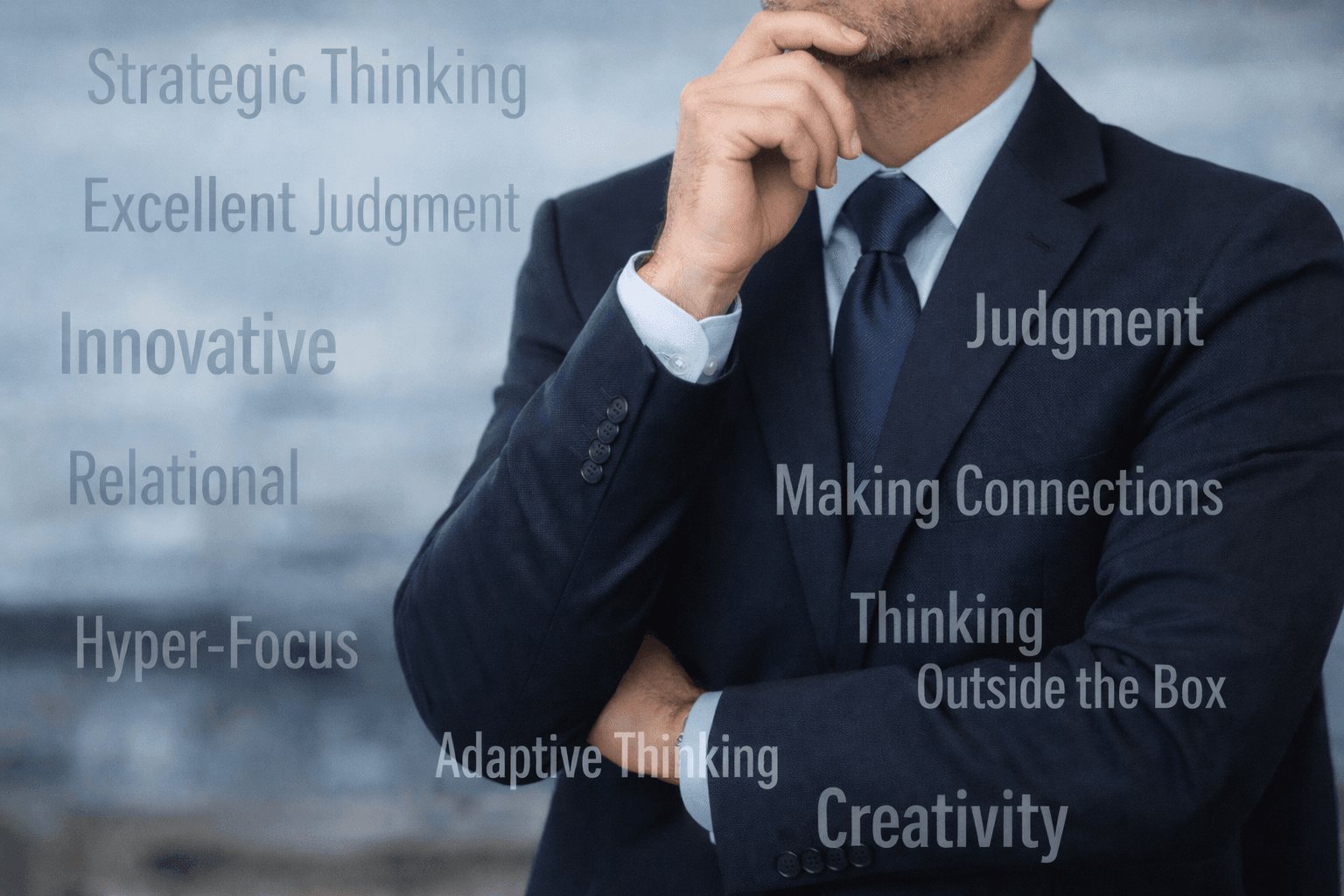
Interview fluency can shape impressions quickly. Candidates who present in a polished sequence often feel easier to evaluate, while candidates who communicate through themes, layered insight, rich detail, or nonlinear recall may be highly capable while creating a different expected impression.
Where a STAR-based format is used as the dominant standard, an organization’s view of competence may become narrower. That narrowing can affect inclusion and talent recognition.
The Emotional Impact on Candidates
This is often where the issue becomes most clinically relevant.
Interview difficulty may not stay contained within the interview itself. People replay what happened, compare themselves to others who seemed smoother or quicker, and wonder how they came across. Some begin to question their competence or experience imposter syndrome. Some become more hesitant about future opportunities. Some start thinking about disclosure or accommodation from a place of uncertainty and fear.
For some neurodivergent individuals, especially those who have spent years compensating, organizing carefully, or trying to meet expected norms, an interview can stir up older experiences of being misunderstood, underestimated, rushed, or judged through a narrow standard.
What may follow can include:
* shame
* reduced confidence
* harsh self-criticism
* confusion about ability
* reluctance to pursue future opportunities
* uncertainty about disclosure
* uncertainty about requesting accommodation

Should a Candidate Disclose?
Many people approach this carefully. Concerns about bias, misunderstanding, and deficit-focused assumptions are real.
Disclosure can also feel complex when a candidate wants their strengths, professionalism, and capability to remain the focus.
From a practical standpoint, candidates often benefit from asking themselves:
* Do I want to request a specific accommodation?
* Would disclosure support my performance?
* Does this workplace seem informed and trustworthy in its approach to neurodiversity?
* What feels most supportive of my clarity and confidence in this setting?
There is no universal answer. The most useful question is often what best serves this person, in this workplace, at this time.
To STAR or Not to STAR?
A Broader View
The STAR method was developed to bring structure to interviews, and it serves that purpose well. At the same time, the way it can be used may privilege a particular style of memory retrieval, verbal sequencing, and real-time organization.
A broad hiring lens can make more room for:
work samples
practical demonstrations
scenario-based exercises
portfolio review
flexible follow-up questions
multiple ways for candidates to show competence
Interview question-and-answer misattunement can influence opportunity, confidence, morale, organizational trust, and self-trust. A broader understanding may create more room for fairness, self-compassion, and a wider definition of competence.
What Can a Candidate Do to Support Themselves?
Candidates cannot shape every element of an interview, though many can strengthen how their abilities come across.
Prepare a small bank of examples in advance.
It often helps to identify several work situations ahead of time that can be adapted to different questions.
Write out the bones of each story.
A brief outline using Situation, Task, Action, and Result can reduce the cognitive load of organizing the answer on the spot. Pausing to orient in the interview may help some to keep those points connected.
Practice aloud, not only in writing.
Many candidates know their examples well and benefit from rehearsal in verbal delivery, especially when sequencing takes effort.
Keep examples simpler than real life.
Work situations are often layered and messy. Interviews usually reward a perception of clarity. A strong answer often follows one thread of the story rather than every part of the full complexity.
Use a grounding phrase when you lose the thread.
For example: “Let me give the short version,” or “The key part of that example was…” A phrase like this can help re-anchor the answer and restore structure.
Lead with the main point.
Candidates who think associatively may benefit from naming the primary challenge or outcome early, then filling in the rest of the sequence.
Request accommodations when that feels helpful.
Some candidates may benefit from receiving interview questions in advance, additional processing time, or another adjustment. An alternative format may include more situational interview questions, which ask what a candidate would do in a given scenario rather than requiring them to organize a past example in real time.
Strengthen the supports that build resilience before and after the interview.
Interviewing can place a real emotional load on candidates, especially when the process feels effortful or high stakes. Alongside preparation, it can help to strengthen the internal and external supports that protect resilience, including self-reflection, clear goals, and supportive relationships. These resources can help a person stay grounded before the interview and recover more steadily afterward.
Hold onto a fuller understanding of your ability.
A structured interview reflects one performance context. Remember that Professional value is more complex.

Help in the Context of Trauma-Informed Therapy
For some neurodivergent individuals, interview experiences can carry more weight than a single professional moment might suggest and therapy may benefit from moving past skills based solution-focus. Many have grown up navigating environments where their way of thinking, communicating, or organizing information attracted frequent correction, misunderstanding, or pressure to perform differently. Over time, those experiences can shape beliefs about competence, belonging, and self-worth.
From a trauma-informed perspective, moments such as interviews may stir older patterns of vigilance, self-doubt, or fear of being evaluated through a narrow lens. These reactions are deeply human and often rooted in earlier relational and developmental experiences.
In therapy, the work may extend beyond interview preparation or practical strategies. Trauma-informed and body-oriented approaches can help people explore the meanings that arise in these moments, notice how the body responds to evaluation or pressure, and examine older beliefs about ability, value, and safety.
As those layers come into clearer view, many people find greater steadiness, self-trust, and freedom to approach opportunities and conversations about their needs from a more grounded place.
About This Post, and Some Supporting Literature
This post is for general educational purposes only and does not constitute psychological advice or therapy and is not intended to replace personalized care from a licensed mental health professional in Canada.
ADDA Editorial Team. (2023, July 17). Top 5 potential benefits of ADHD for employees. ADDA – Attention Deficit Disorder Association.
Austin, R. D., & Pisano, G. P. (2017). Neurodiversity as a competitive advantage. Harvard Business Review, 95(3), 96–103.
Barkley, R. A. (2015). Attention-deficit hyperactivity disorder: A handbook for diagnosis and treatment (4th ed.). Guilford Press.
Logan, J. (2009). Dyslexic entrepreneurs: The incidence, their coping strategies and their business skills. Dyslexia, 15(4), 328–346.
Nicolson, R. I., & Fawcett, A. J. (2008). Dyslexia, learning, and the brain. MIT Press.
This article was authored by Penelope Waller Ulmer, a verified therapist in our network. Learn more about their expertise and approach below.

About Stellocare
This insight comes from Stellocare, Canada’s trusted network of verified mental health professionals. Connect with our therapists today by asking our AI, browsing our list, or requesting a personal match from our social worker.